Daniel Tunnard, Colectivaizeishon Author

A question and answer session with prominent expat Daniel Tunnard: the Englishman in Argentina who wrote a book about taking all 140 city bus routes in Buenos Aires… and lived to tell the tale.

Buenos Aires Museums & Cultural Centers

Fine Arts Museum in Buenos Aires Browse: BuenosTours › Buenos Aires Guide › Things To Do › Museums

Buenos Aires has enough museums to fill several days, but most visitors do not need a long checklist. Pick one collection that matches your interests, then combine it with the neighborhood around it. That usually makes a better day than crossing the city to collect museum names.

The choices below cover major art collections, smaller museums with a strong point of view and two places where immigration and political history become much easier to understand.

For a broad art collection: Museo Nacional de Bellas Artes

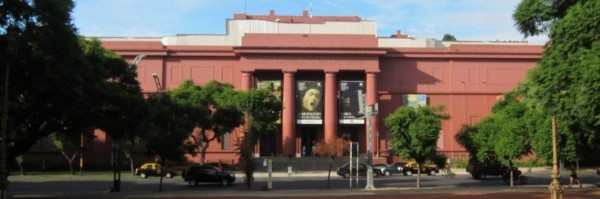
The Museo Nacional de Bellas Artes in Recoleta is the best starting point if you want a broad survey. Its collection brings Argentine art into the same visit as European works, which is useful for seeing local artists in a wider context.

It also fits easily into a Recoleta day. The museum is near the cemetery, parks and Centro Cultural Recoleta, so you can decide how much time to spend indoors without building the whole day around transport.

For Latin American modern art: MALBA

MALBA focuses on modern and contemporary Latin American art. Its collection gives visitors a regional frame rather than treating Argentine art in isolation, and its temporary exhibitions can be as important as the permanent works.

Check the current exhibitions before deciding how long to allow. MALBA sits between Recoleta and Palermo, making it easy to combine with the parks, the Japanese Garden or another stop in that part of the city.

For Evita in political and personal context: Museo Evita

The Museo Evita is housed in a building acquired by the Eva Perón Foundation in 1948 and once used as a temporary home for women and children. Its displays use clothing, photographs, personal objects and archival material to follow Evita’s life, public image, political role and social work.

It is a useful introduction, especially if your visit to Recoleta Cemetery has raised more questions than it answered. The museum is in Palermo, close to the Botanical Garden and Plaza Italia.

For the story of arrival: Museo de la Inmigración

The MUNTREF Museo de la Inmigración occupies part of the former Hotel de Inmigrantes. Its setting matters as much as the exhibits: newcomers once passed through this complex after arriving at the port.

The museum explores the many migrations that shaped Argentina. It is in the northern part of Puerto Madero, with its own access arrangements, so read the official directions rather than relying only on the neighborhood name in a map app.

For a singular Argentine artist: Museo Xul Solar

The Museo Xul Solar is smaller and more personal than the large institutions. Xul Solar moved between painting, invented languages, music, astrology and systems of thought that resist a simple label. The museum incorporates his former home and rewards visitors who enjoy unusual artists and compact collections.

Because it is in Barrio Norte, it can be combined with an unhurried walk or café stop rather than treated as an isolated expedition.

In La Boca: Quinquela Martín and Fundación Proa

La Boca offers two very different art stops close together. The Museo Benito Quinquela Martín connects paintings of the port with the artist’s home and his public contribution to the neighborhood. Fundación Proa, beside Caminito, presents changing modern and contemporary exhibitions.

See our La Boca guide before deciding how to fit them into the rest of your visit.

Cultural centers are worth checking too

Buenos Aires’ cultural centers are not simply smaller museums. Their programs can include free exhibitions, concerts, talks, film and activities for children. The Usina del Arte in La Boca is particularly good when its current program gives you a reason to go. Centro Cultural Recoleta is easier to add to a day already planned around Recoleta.

Programs change often, which is precisely the point. Check what is on during your dates instead of visiting only because a building appears on a generic list.

How to plan a museum day

  • Check the institution’s own website on the day you plan to visit. Opening days, exhibitions, ticket systems and access arrangements can change.
  • Choose by interest first, then by geography. Bellas Artes works naturally with Recoleta; MALBA or Museo Evita with Palermo; and Quinquela Martín with Proa and Caminito.
  • Leave room for one good collection. A museum followed by a neighborhood walk is usually more memorable than three rushed entrances.
  • Do not assume every museum closes on Monday. The schedules differ, which is another reason to use the official links above.

For help putting the neighborhoods and their history together, start with our Buenos Aires Guide. If art, architecture or political history is a priority for your group, a private Buenos Aires tour can be planned around those interests.

Cafe Margot, Boedo

Cafe Margot is a classic Buenos Aires café, that has been serving up coffee, medialunas, beer, wine and its famous turkey sandwiches for well over 100 years, in the atmospheric neighborhood of Boedo.

El Banderín

If ever a Notable Bar in Buenos Aires deserved its name, then that bar is El Banderîn. The Spanish word for banner, the walls of El Banderín are covered with football banners from all round the world. Originally opened in the 1930s and named El Asturiano, the banners started in the 1960s with a customer who returned from holiday in Austria bringing a club banner back as a present for the football-mad owner. The trend caught on, and by the time a former customer of the bar had gone to Spain to play professional football and was sending a new banner every month, the name had been changed and its destiny sealed.

El Banderín, Abasto
El Banderín, Abasto
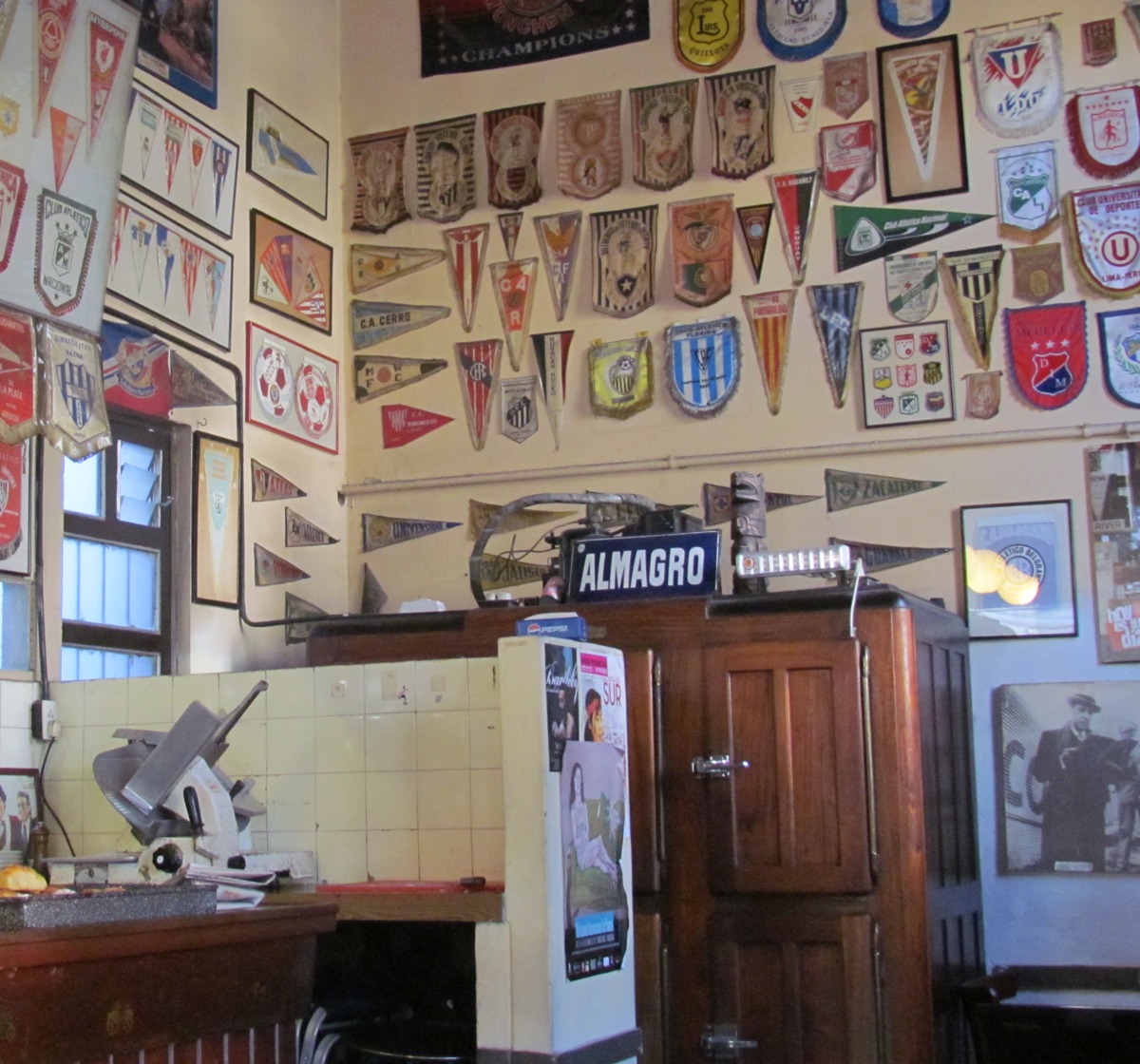

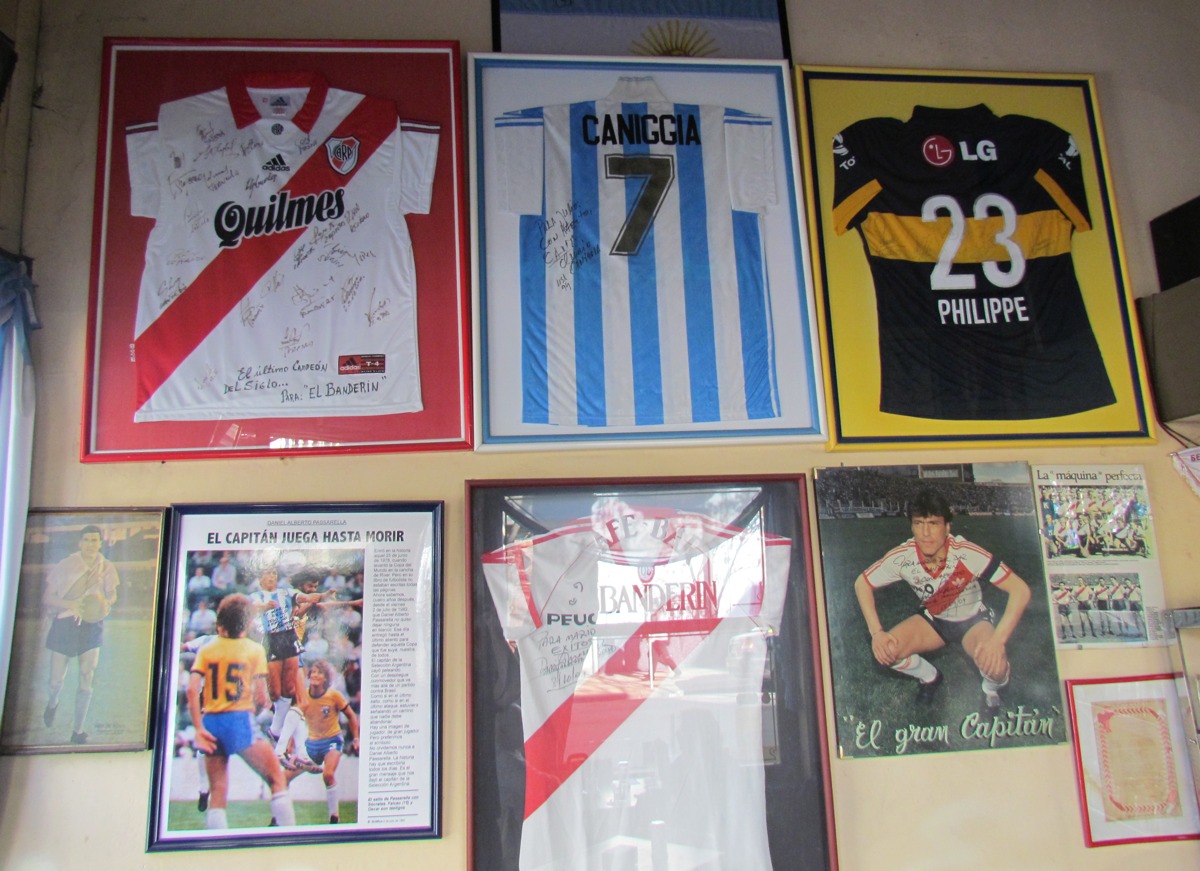
The bar now boasts hundreds of banners, from the largest clubs in the world, down to some real oddities. One wall is devoted to Argentina, and features signed shirts from the national side as well as River Plate and Boca Juniors (2 from River – the owner is a diehard fan).
El Banderín, Abasto

El Banderín, Abasto
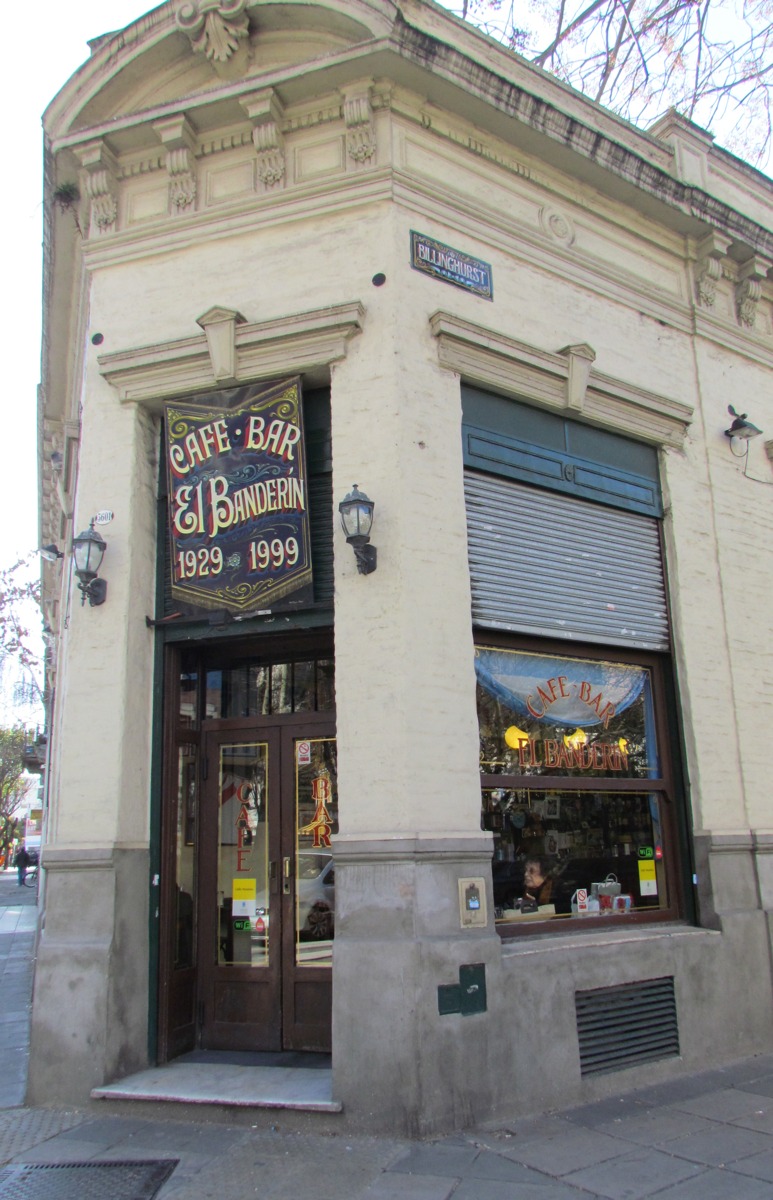

It’s not a large space, but it’s packed with character and you could spend a happy half hour studying all the banners and wondering on the stories behind them. On a Monday evening a live football-themed radio show is recorded in the bar, musing on the events of the previous weekend. If you’re in the area of the Abasto shopping centre, it’s well worth making the detour to El Banderín for a colourful slice of Buenos Aires life.
El Banderín, Abasto

El Banderín, Abasto


El Banderín, Abasto

El Banderín, Abasto

El Banderîn: Guardia Vieja 3601
Subte: Carlos Gardel, Line B

This page is part of a series examining the Notable Bars of Buenos Aires.

Las Violetas

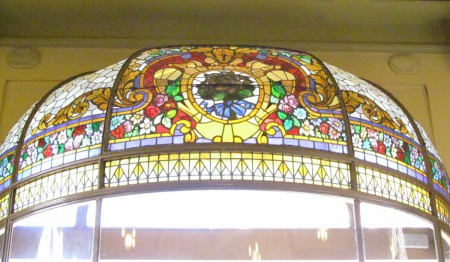
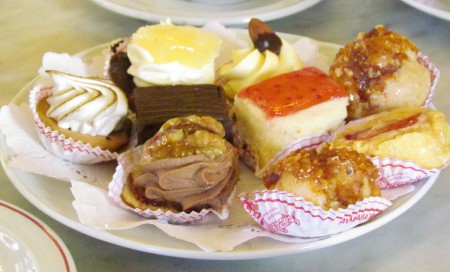
Las Violetas is a stylish place. With murals, stained-glass canopies and rows of delicious-looking cakes on display, it’s obviously somewhere which attracts a certain type of clientele. When I visit, on a Sunday afternoon, it’s full of noisy families and groups of ladies on what could be their annual meetup over coffee and cakes.
La Violetas, Almagro

Cakes, La Violetas, Almagro


Las Violetas is a Confiteria, that is to say it makes and sells cakes, as well as offering a large cafe ares to have a cup of coffee with your cake, and like most Confiterias in Buenos Aires is not a place to eat or drink, rather a place to talk. Nobody is rushing, the waiters included, and the high ceilings and sunlight streaming in from outside give it an open and welcoming feeling as witnessed by the fact it has been in business on the same corner in Almagro for over 125 years.
Las Violetas, Almagro

Window Canopy, Las Violetas, Almagro
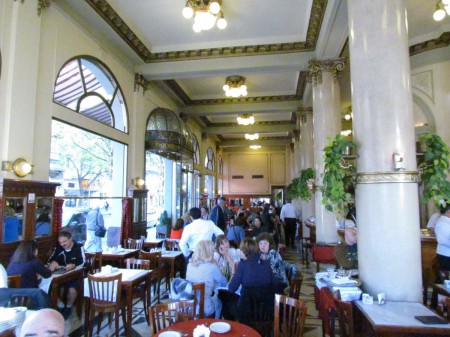

It may not be obvious from the surroundings (which underwent a major reconstruction at the end of the 1990s), but La Violetas played a role in the struggle against the Dirty War when it was a regular meeting place for the Madres de la Plaza de Mayo in the 1970s.
Las Violetas, Almagro

Las Violetas, Almagro


I must confess that it’s not really my kind of place. Maybe a little too bright, a little too neat, a little too elegant for me to feel totally at ease, however Las Violetas is the sort of place that I’m glad exists, proving that not everything in this world has to change and be replaced, that some ideas just work well and can stay that way.

Las Violeta: Avenida Rivadavia 3899
Subte: Castro Barros, Line A

This page is part of a series examining the Notable Bars of Buenos Aires.

Café de la Esquina

Avenida del Libertador is, to be honest, ridiculously long. No avenue should be that long. It starts in Retiro and makes its way northwards, getting swankier by the moment. By the time it leaves Capital Federal it has covered more than 80 blocks (each block being roughly 100 metres long), and actually continues into Provincia for at least another 50 or so. I don’t know the Belgrano stretch very well, I’ve crossed it a few times, or hunted for a cash point when visiting the nearby Barrio Chino, but my impression was one of tall apartment blocks and modern, brightly lit ice-cream parlours and cafes.

Cafe de la Esquina, Belgrano

Cafe de la Esquina, Belgrano


Sitting on the corner of Libertador and Olazabal, about 60 blocks from Retiro, the aptly-named and absolutely not-brightly-lit-in-the-slightest Cafe de la Esquina is a nice break from the local trend. In fact it may have gone a little too far – it is so dark and cosy inside that it actually appears, from the outside to be closed. Happily not the case, inside it has tall ceilings and wood-panelled walls decorated with a familiar array of old pictures and ornaments.
Cafe de la Esquina, Belgrano

Bar area, Cafe de la Esquina, Belgrano


It certainly has the look and feel of an old Notable Bar, but according to their website (the waitress wasn’t much help when I asked), whilst the building dates from 1906 the bar itself has only been going since 1983.
Cafe de la Esquina, Belgrano

Cafe de la Esquina, Belgrano


Despite that, I liked it nonetheless. It being dark and chilly outside it was nice and cosy space with an ancient-looking open stove giving heat in the corner and lace curtains in the windows. It felt a bit like your gran’s living room, although one with lots of tables and a very high roof.
Cafe de la Esquina, Belgrano

Cosy open stove, Cafe de la Esquina, Belgrano

Cafe de la Esquina: Avenida de Libertador 6196
Colectivos: 15. 64, 118

This page is part of a series examining the Notable Bars of Buenos Aires.

Ocho Esquinas

Surrounded by fields when first built in 1938, Bar Rojo opened in 1944 named after its owner, Spaniard Fernando Rojo. Before long it became known as the Ocho Esquinas (8 Corners), due to its location in Colegiales on a junction where 3 large avenues cross (I could only see 6 corners, but who’s counting, right?).
Ocho Esquinas, Colegiales
Ocho Esquinas, Colegiales


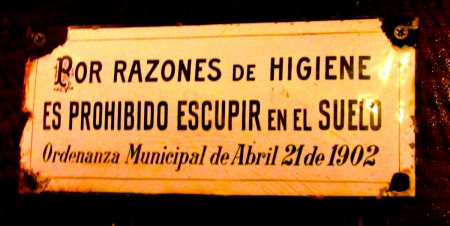
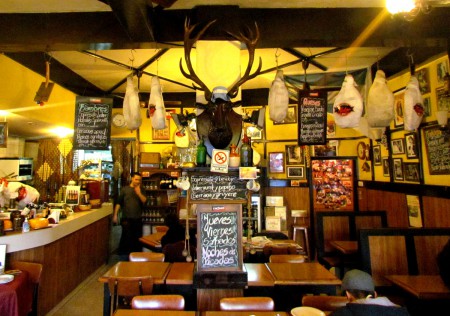
The place is small and quiet on the Saturday afternoon that we visit. I’m starting to recognise common elements in the Notable Bars that I’m visiting and at a glance, I can tell that the tables are all originals and the floor and bar have not been changed since opening in the 1940s. A quick chat with the waiter confirms all this (who also tells me that even the coffee cups are over 70 years old, recently a large stock of them was found in the attic), but Ocho Esquinas has one more thing unchanged since its early days which I’d not come across before – the menu.
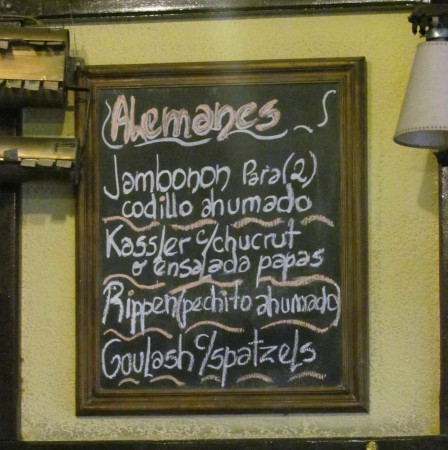
The German Menu, Ocho Esquinas, Colegiales
The German Menu, Ocho Esquinas, Colegiales


The Spaniard Rojo, came to Argentina by boat, where he met a German chef whom he invited to work in his new bar when it opened. The chef did so, on the condition that he would be allowed to include 4 German dishes on the menu. Rojo agreed and those four items have remained specialities of the house ever since. They’ve not been added to nor removed, just stayed the way they were. Ranging from Goulash to a classic Pork Shank for two, these are not your average Buenos Aires offerings.
Ocho Esquinas, Colegiales

Ocho Esquinas, Colegiales
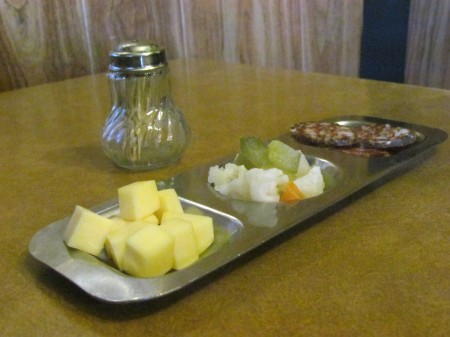

On Fridays and Saturdays, the bar offers a tango evening to accompany their German specialities, and I made a mental note to return to experience it. I immediately like the bar and its atmosphere and the mix of classic Porteño with a German twist certainly makes it stand out from many of its fellow Notable bars.
Picada con Cerveza, Ocho Esquinas, Colegiales

Picada con Cerveza, Ocho Esquinas, Colegiales

Ocho Esquinas: Av Forest 1186
Colectivos: 44, 65

This page is part of a series examining the Notable Bars of Buenos Aires.

El Miramar

El Miramar doesn’t have the same feel as many of the other bars I’ve visited so far. It shares the high roof and dark wooden furniture with many of its fellow Notables, but there is a distinct lack of faded advertising on the walls and the bottles stacked behind the bar look used, rather than relics from a previous age. As I enter around 4pm the bright interior is filled with tables, all with white tablecloths left over from lunch.

El Miramar, Buenos Aires

El Miramar, Buenos Aires


I order a coffee and take a seat, next to a glass cabinet which divides the space in two, making a smaller more bar-like area by the entrance and a larger area towards the back reserved for diners. As the waiter brings my coffee over, I ask my usual questions about the history of the bar (opened in 1950) and what sort of food they serve. He brings me over a menu and then disappears for a minute and comes back with the specials board and sitting down opposite me he then proceeds to talk me through it. The food has a definite Spanish and French influence and even includes frogs legs and snails. The smoked boar platter sounds especially good and catches my eye, it certainly makes a change from the usual menu of sandwiches, milanesa and pizza found in a lot of bars and restaurants.
El Miramar, Buenos Aires

El Miramar, Buenos Aires


He then disappears again and returns with a map of the Notable Bars produced by the city (it’s the 4th copy I’ve been given so far) and he talks me through his favourite spots, with the help of his colleague who stays safely behind the bar grunting contributions. They both like Los Laureles in Barracas and Carlitos in San Cristóbal (still has the original tin bar, although sadly turns out to have closed down). He tells me about the Bar Chino in Pompeya, also closed, but where you had to take an umbrella if it was raining due to the leaky roof.
El Miramar, Buenos Aires

El Miramar, Buenos Aires


We sit there for 20 minutes or so as they reminisce about the various bars they have known (El Puenticito in Barracas, always full of taxi drivers and a Japanese bar where a sandwich and a beer cost 200 pesos, but really good quality!), until he stands up, shakes my hand goes and gets his coat and heads home, telling me the coffee is on him. There is no messing about at El Miramar, and as I leave I make a mental note to return one day. I have a date with some smoked boar.

El Hipopótamo: Sarandí 1190
Subte: Line E, Entre Rios

This page is part of a series examining the Notable Bars of Buenos Aires.

El Progreso

Update!

El Progreso has reopened and is looking great – highly recommended!
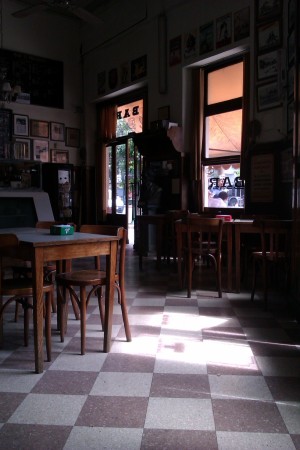
El Progreso is back
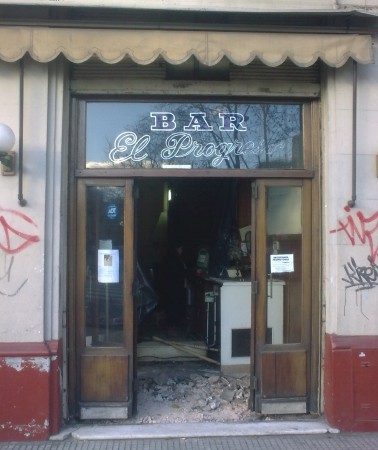
El Progreso is back

El Progreso, Barracas
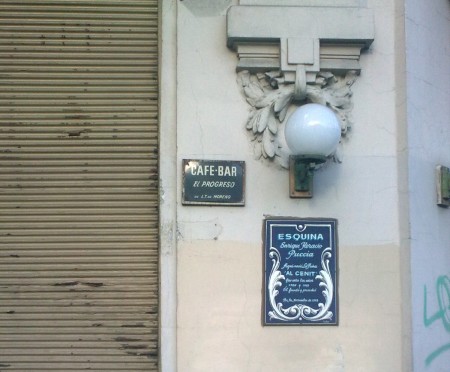
El Progreso, Barracas


They say progress is a good thing, but for me and El Progreso it means that we are not destined to meet, at least not for the time being. I hope we get another chance.
El Progreso, Barracas

El Progreso, Barracas

El Progreso: Montes de Oca 1700
Colectivos: 12, 70, 22

This page is part of a series examining the Notable Bars of Buenos Aires.

El Hipopótamo

El Hipopótamo, San Telmo

El Hipopótamo, San Telmo

For many tourists San Telmo starts at Plaza de Mayo and stops at Plaza Dorrego – very few will venture southwards and beyond San Juan the tourist traps dry up and the area buzzes with local flavour. The bar dates from 1909 but it has not always gone by the name it has today. Originally called La Estrella del Sur, and later renamed to Don Pedro (it stands opposite a statue commemorating the city’s founder Don Pedro de Mendoza) the owner gave it its current moniker about 30 years ago as a tongue-in-cheek tribute to an upscale establishment popular at the time with upper-class society. Whilst its patrons may not be as well-heeled as those of its namesake, it has outlived the original and is still going strong, offering classic Porteña picadas and café fare.
El Hipopótamo, San Telmo

El Hipopótamo, San Telmo


Filled with dark furniture, classic advertisements and posters, the interior has a warm feeling and large windows emblazoned with the bars logo allow some great people watching opportunities on the passing streets.
El Hipopótamo, San Telmo

El Hipopótamo, San Telmo


It may only be a few blocks from Plaza Dorrego but the clientele is most definitely local and when I visited most were nursing a cortado, glued to the TV playing silently above the door.
El Hipopótamo, San Telmo

El Hipopótamo, San Telmo


El Hipopótamo is in a great location, literally across the street from another Notable Bar, Bar Britanico, and at the entrance to Parque Lezama, one of the most interesting parks in the city. With its warm, cozy interior El Hipopótamo is well worth continuing the couple of blocks past Plaza Dorrego to experience one of the most classic bars in San Telmo.
El Hipopótamo, San Telmo

El Hipopótamo, San Telmo

El Hipopótamo: Brasil 401
Colectivos: 62, 22, 29

This page is part of a series examining the Notable Bars of Buenos Aires.