The Buenos Aires Essentials Tour: find your footing in Buenos Aires
Category: Buenos Aires Local Tours Archive
Historic articles originally published by Buenos Aires Local Tours, preserved by BuenosTours. These are dated archives, not current travel advice or current tour offers.
I’m a big fan of the alternative Tube map, so I though it would be fun to (badly) translate the station names of the Buenos Aires Subte system into English. This is what the Buenos Aires Undergr looks like (click on the image for the big version).
I had most problems with the stations named after people. Where I’ve been able to discover the origins of the name, that’s what you have, but a few have me stumped and appear in their original form. I will also confess to one translation being a total guess, but I’m not telling which one.
I also know that the H Line has now been extended to add “Hospitals”, but I was unable to find an online version of the latest map. Even the map on the official site still finishes at “Patrician’s Park”.
Fantastic photo tweeted by Commander Chris Hadfield and taken from the International Space Station of the River Plate emptying into the ocean. Buenos Aires can clearly be seen on the bottom bank of the river, as can Montevideo near where the mud ends. Bear in mind that the width of the river at Buenos Aires is 35 miles.
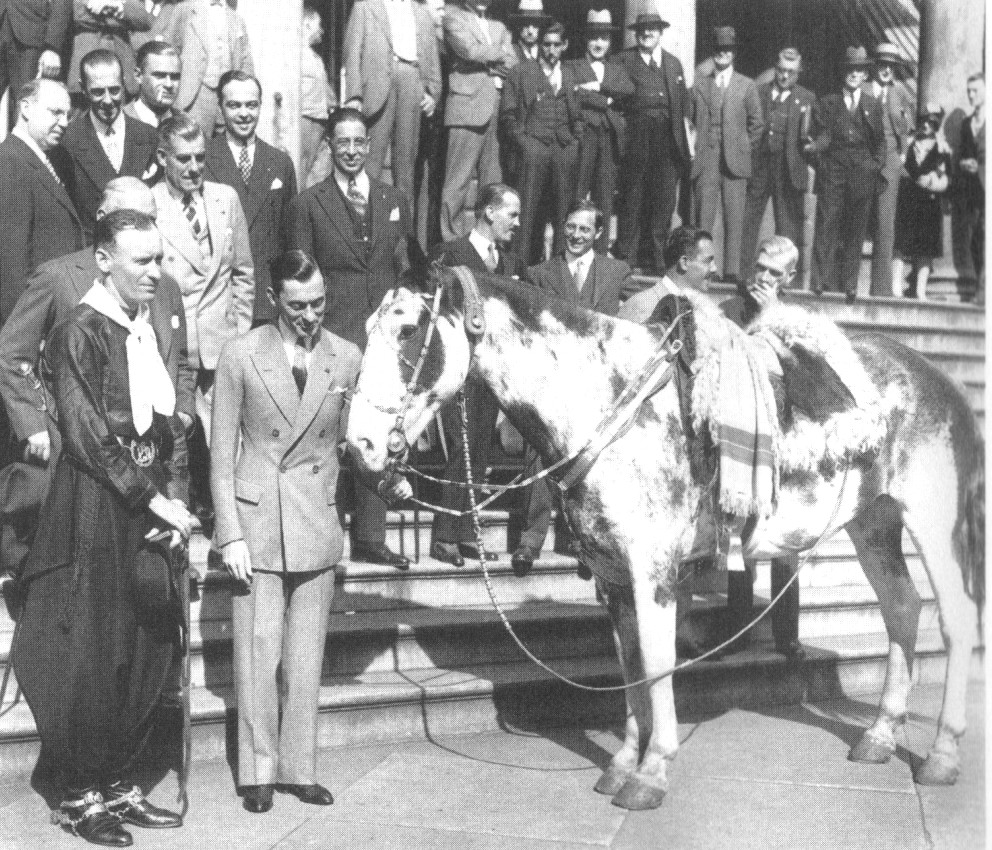
In the 1920’s two horses and one teacher undertook a mammoth journey and their exploits made them unlikely celebrities all over the world. Aimé Tschiffely, born in Berne, Switzerland had been working as a teacher in Buenos Aires and aged 30, having decided his life needed some adventure, he decided to ride 2 horses 21,500km from Buenos Aires to New York.
The horses he chose, Gato (Cat) & Mancha (Spot) were 15 and 16 years old respectively. Both were wild Criollo horses, direct descendants of the horses brought to Argentina by the Spanish in the 1500s, and neither had been broken, having spent their lives up until that point loose on the Pampa.
Gato and Mancha
Tschiffely set off with his two sturdy companions on the 24th April 1925, leaving from the Sociedad Rural in Palermo, equipped with a rifle, a pistol and silver coins to pay Indian guides he would meet along his way.
The journey proved to be arduous, crossing jungle, swamps and at one point crossing the 5,900 metre Paso del Condór in Bolivia, but Gato & Mancha were more than up to the challenge. They may not have been up to the pedigree expected by Argentine society at the time, but Tschiffely wrote of them, “Their sturdy legs, short thick necks and Roman noses are as far removed from the points of a first-class English hunter as the North Pole from the South. Handsome is and handsome does, however, and I am willing to state my opinion boldly that no other breed in the world has the capacity of the Criollo for continuous hard work.“.
Gato fell lame in Mexico after being kicked by a mule but Tschiffely and Mancha continued onwards and 3 years, 4 months and 6 days after leaving Palermo, they arrived on 5th Avenue in New York on the 20th September 1928 (the date is now National Horse Day in Argentina) to a heroes welcome.
Gato & Mancha lived out their well-deserved retirement in Argentina and they died aged 36 and 40 respectively in the 1940s. Their preserved remains are displayed in the Emilio Udaondo museum in Luján. Tschiffely died aged 59 and is buried on an estancia in Ayacucho.
A more detailed account of the journey can be found here.
Whilst I love a good Tripadvisor review (currently 83 and counting, have you written yours yet?), I also enjoy reading more detailed writeups that the tour gets on personal blogs. It always helps me to see the tour in the same way that a tourist sees it, and I enjoy hearing about what they take away from it, plus there’s usually some great photos!
I’ve recently had 2 such writeups that I would recommend you also take a look and see what people get from my tour and thanks to both Dominika and Angela for taking the time to document their time with me!
Some more great coverage – Real Argentina published a guide to alternative ways of seeing Buenos Aires and I get a mention: Alternative Tours of Buenos Aires
My free daily walking tour visits the Abasto Shopping Centre, housed in the old central market, a beautiful Art Deco building constructed in the 1930s. Coming in a side door, we cross a large, enclosed area before making our way to the top level. This lower lever often houses promotions and entertainment for the kids and at the moment is home to an enormous scale model of Buenos Aires. UPDATE: As of mid-September the model is still there although cordoned off a little more than before, an information sign says the scale is 1500/1.
Buenos Aires Scale Model
At first glance, it’s an impressive work, giving a good idea of the scale and spread-out nature of the city, but as you start to examine it more closely you realise that every single building in the city has been modelled. It’s truly an amazing piece of work and the following photos are some of the highlights. Click on the photo for the full-size version.
The level of detail goes down to the each individual building.
Avenida de Mayo, from Plaza de Mayo leading up to Plaza de Congreso
Retiro, Recoleta & Palermo and Belgrano seen from the south. Torre Inglesa & Retiro station in the foreground
Parque Centenario
La Boca, note La Bombonera middle left and the diagonal of Caminito in the bottom left
Avenida 9 de Julio in all its glory, as seen from the south. Note the Obelisco about 2/3 of the way up.
Looking west along Avenida Pueyrredon with Once in the distance and Facultad de Medicina on the left
I came across this blog post yesterday which looks at stereotypes of each US State based on typing “Why is {State} so” into Google and seeing what comes up on the autocomplete. It’s fun little idea and I decided to undertake the same experiment for South America.
Argentina
First up, Argentina and the most popular question asked about the country, according to Google, is all to do with skin-colour. Second and fourth we have question relating to money, the latter one possibly explaining the former and number 3 is not surprisingly football (the answer is they didn’t qualify, but then neither did Holland, France or Germany).
If we change the question around a little and ask about the inhabitants rather than the country we hit a persistent stereotype straight away.
Interestingly when we run the same queries in Spanish we get slightly different results.
Searching for “Why are Argentinians so..” in Spanish shows a very superficial obsession with the top results being good-looking, ugly and blonde.
Uruguay
As for Uruguay, people are either questioning their national team’s high position in the FIFA ranking, or where does the name of the country come from.
Only one question pops up for the residents, and its one we see for every country except Brazil & Bolivia – why are the people white? It is clearly a common assumption that South America is still mostly populated by indigenous people and the number of “Europeans” obviously takes visitors by surprise.
Brazil
Moving to our larger neighbour in the North, let’s see what people have been asking Google about Brazil.
Maybe it’s good at football because it’s big and violent? As for the inhabitants we can see some familiar preconceptions cropping up, although numbers 2 and 4 surprise me a little as these are not questions I’ve ever asked myself.
Bolivia
I’m sorry Bolivia – there seems to be only one thing on the mind of Googlers when it comes to you.
Chile
And the burning questions everybody wants to ask about Chile, why is it so long and thin?
Although this seems to have an effect on its residents – long country, long face?
Colombia
Next up, Colombia. Sadly only one question actually appears and it is very predictable and unlike most stereotypes isn’t based entirely on current reality.
Whilst the country might be seen as dangerous, this image obviously doesn’t rub off on the inhabitants.
South America
And finally, searching for the entire continent sadly reveals something of how it is seen from the outside.
Buenos Aires is often compared to other cities around the world. Many a guidebook waxes lyrical about the “Paris of the South”. Puerto Madero is Manhattan (at least to those who have never been to Manhattan) and the leafy parks of Palermo have reminded more than one visitor to the large open space of Central Park. I like a good comparison and today I began wondering how did Buenos Aires stack up to other world cities in terms of size. I know it’s 80 square miles with a population of a shade under 3 million, but what does that mean, when comparing to another city I know well, such as London? I decided to find out.
London vs Buenos Aires (click for full size)
Above is a map of London, taken from Google maps with the outline of Buenos Aires at the same scale overlaid. I’ve highlighted some of the well-known spots in the city to make it easier to gauge the size. The Plaza de Mayo is roughly where the London Bridge is, which puts Plaza Dorrego round about Waterloo, Caminito in Peckham and Plaza Italia the other side of Regents Park on Primrose Hill and Congreso de Tucuman way out in Hendon.
Paris vs Buenos Aires (Click for full size)
Paris is a much smaller city and the Péripherique fits nicely inside Capital Federal. Travel from Recoleta to Mataderos and you cross the entire Buenos Aires of the North. There might be architectural influences, but there’s a whole load more of it here than up there.
New York vs Buenos Aires (Click for full size)
Moving to New York and the scale seems much more in line with each other. The 5 boroughs dwarf Capital Federal with Mataderos down on Governor’s Island and Plaza de Mayo up near Jackson Heights and La Guardia.
San Francisco vs Buenos Aires (Click for full size)
San Francisco fits quite nicely into the Argentine capital. If Recoleta is downtown, then you have to cross the Golden Gate Bridge to get to Congreso de Tucuman, and buy a boat to get to the market at Liniers.
Geneva vs Buenos Aires (Click for full size)
Here we have my old hometown of Geneva, totally swamped by my new place of residence. The city itself is about one tenth of Buenos Aires and both Caminito and the end of the D Line both find themselves in France either side of the town where one of Buenos Aires’ most famous sons, Jorge Luis Borges is buried.
These images are not the most precise maps in the world (and I make no guarantee of their complete accuracy), but are a bit of fun and help put the size of Buenos Aires, and the journeys we take here every day into perspective. I’ll keep adding more over the next few days – if there is a city you would like me to add, let me know in the comments.
Rome vs Buenos Aires (Click for full size)
Sydney vs Buenos Aires (Click for full size)
**UPDATE**
As requested by Beatrice, here is the clash of the sprawls – Buenos Aires takes on Los Angeles
Los Angeles vs Buenos Aires (Click for full size)
And especially for my friend Daniel here is Stockport masquerading as Plaza Once
It probably won’t come of any great surprise that I hold somewhat of a fascination with the humble Buenos Aires colectivo. They are everywhere, speeding down the wide avenues of Palermo and clogging the narrow streets of Microcentro, yet to a new arrival in the city thinking of catching one they seem impossibly complicated and confusing. One of my main motivations in starting Buenos Aires Local Tours was to help visitors to the city to decipher the system and allow them to begin to discover the city by themselves, as the residents do. Catching a colectivo in Buenos Aires is an adventure and if it drops you roughly where you need to be it’s quite an achievement!
So, when I came across a project called Colectivaizeishon, in which a Brit called Daniel Tunnard (interview with him here) was undertaking to catch all of the 140 bus lines in the city and write about the experience I was fascinated. A little annoyed about not having had the idea first, but fascinated nonetheless.
I got in touch with Daniel, complimenting him on such a great idea and confessing my own obsession with the Buenos Aires colectivo, and then began following his adventures as they appeared on his blog. Then, in April, with the end of the project in sight, he invited me to spend a day on the buses with him. To some people, the idea of sitting (or standing) on a collection of urban buses for up to 13 hours might not appeal, but I leaped at the chance and a couple of days later made my way to Palermo in the early hours of a Wednesday morning to begin the adventure.
At least the Subte is empty at 6:30am
Our first bus of the day was the 161 which would take us to Villa Lugano. However it turns out that the 161 doesn’t run to Villa Lugano anymore, it only goes as far as Liniers. Now this would have had me scurrying for cover to recalculate my day’s travel, but Daniel took it in his stride and we got on anyway and set off for Liniers. As we passed through places I had either never heard of or only seen as names on the side of colectivos, Daniel got busy noting down the things that were happening around us. It was a little bit disconcerting to see things you said immediately transcribed, but it also added a certain gravitas to the proceedings. As we approached San Martin I commented that it was very foggy, upon which Daniel began scribbling in his notebook and I glanced over to see my throwaway comment had been immortalised as the much more dramatic “Fog Descends”.
Fog Descends
Approaching Liniers, after some frantic searching in the Guia T, it was decided that we’d reached the end of the line and that it was time to jump off and catch the next bus, the 185 which would get us to our original destination of Villa Lugano. The 185 took us through the wonderfully named La Matanza (The Massacre, a reference to an attack on Spanish settlers by some of the locals in the 1500s), which as a town has the even more wonderful slogan La Matanza Avanza.
Villa Lugano
Daniel happily confesses that one of the main problems about catching a bus and then writing about the experience is that nothing much actually happens. Having spent a day with him, I can indeed attest to that fact, and a routine is quickly begun, consisting of sitting on a bus for 90 minutes, getting off said bus, and then after the quickest of breaks, getting on another bus. From Villa Lugano we caught the 115 which took us past enormous amounts of damage from the storm that had hit the city a few days previously. I’d barely been aware of it at the time, but clearly out here it had had a huge impact and the clean up had barely begun.
Storm Damage, Mataderos
The 115 took us as far as Retiro, where we didn’t hang around long and jumped on the 126 which would take us to Mataderos. I was very much looking forward to the end of the 126 as we were going to be stopping at a Colectivaizeishon favourite spot for lunch – the Petrobras service station by the General Paz ring road! And it turns out that they do a pretty decent lunch there. We sat down and ate, and I was feeling pretty happy with myself as we had completed the 4 lines we had set out to do that day, and it was only 1pm!
So, I innocently asked what was next, would we be catching any more lines today, only to have feel my spirits sink when I was I informed that we now had to catch all 4 back the other way. So, not only is he catching all 140 lines, he has to catch them in BOTH directions. So, finishing my ham and cheese panini we rejoin the queue to catch the 126 back to Retiro for the second time that day.
An empty 115 leaving Retiro
The 115 and the 185 then dutifully returned us to Liniers (where I was privileged to be shown Daniel’s most highly-recommended public toilets in Buenos Aires, although I’m sworn to secrecy as to their actual location – if word gets out they’ll be ruined), whereupon we caught the 161 which trundled through miles of rush hour traffic to return us to Palermo about 12 hours after we had left it.
After a full day I’m not sure I would want to take 136 more lines, but I certainly got to see parts of Buenos Aires I would never normally get to see, and whilst nothing really happened (neither good nor bad), I can now see the 161 in Plaza Italia and know with smug inner-nerd satisfaction that I have caught it all the way to Liniers and back. Not many people can say that, now can they?
Parque de la Cuidad seen from the 115
Cookie Consent
We use optional cookies to improve your experience. Sadly, no real cookies.
Cookie Preferences
Manage your cookie preferences below:
Essential cookies enable basic functions and are necessary for the proper function of the website.
Name
Description
Duration
Geolocation Config
This cookie is used to store the consent settings based on the visitor's location.
350 days
Cookie Preferences
This cookie is used to store the user's cookie consent preferences.
350 days
CloudFlare provides web performance and security solutions, enhancing site speed and protecting against threats.
The cf_ob_info cookie provides information on: The HTTP Status Code returned by the origin web server. The Ray ID of the original failed request. The data center serving the traffic
session
__cfseq
Sequence rules uses cookies to track the order of requests a user has made and the time between requests and makes them available via Cloudflare Rules. This allows you to write rules that match valid or invalid sequences. The specific cookies used to validate sequences are called sequence cookies.
session
cf_clearance
Whether a CAPTCHA or Javascript challenge has been solved.
session
_cfuvid
The _cfuvid cookie is only set when a site uses this option in a Rate Limiting Rule, and is only used to allow the Cloudflare WAF to distinguish individual users who share the same IP address.
session
__cflb
When enabling session affinity with Cloudflare Load Balancer, Cloudflare sets a __cflb cookie with a unique value on the first response to the requesting client. Cloudflare routes future requests to the same origin, optimizing network resource usage. In the event of a failover, Cloudflare sets a new __cflb cookie to direct future requests to the failover pool.
session
__cfruid
Used by the content network, Cloudflare, to identify trusted web traffic.
session
__cf_bm
Cloudflare's bot products identify and mitigate automated traffic to protect your site from bad bots. Cloudflare places the __cf_bm cookie on End User devices that access Customer sites that are protected by Bot Management or Bot Fight Mode. The __cf_bm cookie is necessary for the proper functioning of these bot solutions.
session
cf_chl_rc_m
These cookies are for internal use which allows Cloudflare to identify production issues on clients.
session
cf_chl_rc_ni
These cookies are for internal use which allows Cloudflare to identify production issues on clients.
session
cf_chl_rc_i
These cookies are for internal use which allows Cloudflare to identify production issues on clients.
session
__cfwaitingroom
The __cfwaitingroom cookie is only used to track visitors that access a waiting room enabled host and path combination for a zone. Visitors using a browser that does not accept cookies cannot visit the host and path combination while the waiting room is active.
session
cf_use_ob
The cf_use_ob cookie informs Cloudflare to fetch the requested resource from the Always Online cache on the designated port. Applicable values are: 0, 80, and 443. The cf_ob_info and cf_use_ob cookies are persistent cookies that expire after 30 seconds.
session
These cookies are needed for adding comments on this website.
Name
Description
Duration
comment_author_url
Used to track the user across multiple sessions.
Session
comment_author_email
Used to track the user across multiple sessions.
Session
comment_author
Used to track the user across multiple sessions.
Session
Google Tag Manager simplifies the management of marketing tags on your website without code changes.
Name
Description
Duration
td
Registers statistical data on users' behaviour on the website. Used for internal analytics by the website operator.
session
cookiePreferences
Registers cookie preferences of a user
2 years
Name
Description
Duration
nitropack_webhook_sync
Session
nitroCachedPage
Session
WP Consent API is a plugin that standardizes the communication of accepted consent categories between plugins.
Name
Description
Duration
wp_consent_{category}
Stores your consent preference for a specific cookie category (e.g., functional, marketing). It ensures consistent consent management across WordPress plugins supporting the WP Consent API.
30 days
Statistics cookies collect information anonymously. This information helps us understand how visitors use our website.
Google Analytics is a powerful tool that tracks and analyzes website traffic for informed marketing decisions.
Used to monitor number of Google Analytics server requests when using Google Tag Manager
1 minute
_gid
ID used to identify users for 24 hours after last activity
24 hours
_ga_
ID used to identify users
2 years
_gali
Used by Google Analytics to determine which links on a page are being clicked
30 seconds
_ga
ID used to identify users
2 years
__utmx
Used to determine whether a user is included in an A / B or Multivariate test.
18 months
__utmv
Contains custom information set by the web developer via the _setCustomVar method in Google Analytics. This cookie is updated every time new data is sent to the Google Analytics server.
2 years after last activity
__utmz
Contains information about the traffic source or campaign that directed user to the website. The cookie is set when the GA.js javascript is loaded and updated when data is sent to the Google Anaytics server
6 months after last activity
__utmc
Used only with old Urchin versions of Google Analytics and not with GA.js. Was used to distinguish between new sessions and visits at the end of a session.
End of session (browser)
__utmb
Used to distinguish new sessions and visits. This cookie is set when the GA.js javascript library is loaded and there is no existing __utmb cookie. The cookie is updated every time data is sent to the Google Analytics server.
30 minutes after last activity
__utmt
Used to monitor number of Google Analytics server requests
10 minutes
__utma
ID used to identify users and sessions
2 years after last activity
_gac_
Contains information related to marketing campaigns of the user. These are shared with Google AdWords / Google Ads when the Google Ads and Google Analytics accounts are linked together.
90 days
Marketing cookies are used to follow visitors to websites. The intention is to show ads that are relevant and engaging to the individual user.
Google Ads is an online advertising platform that enables businesses to create targeted ads displayed on Google search results and partner sites.
Google uses cookies for advertising, including serving and rendering ads, personalizing ads (depending on your ad settings at g.co/adsettings), limiting the number of times an ad is shown to a user, muting ads you have chosen to stop seeing, and measuring the effectiveness of ads.
90 Days
FPGCLGB
Google uses cookies for advertising, including serving and rendering ads, personalizing ads (depending on your ad settings at g.co/adsettings), limiting the number of times an ad is shown to a user, muting ads you have chosen to stop seeing, and measuring the effectiveness of ads.
90 Days
_gac_gb_
Google uses cookies for advertising, including serving and rendering ads, personalizing ads (depending on your ad settings at g.co/adsettings), limiting the number of times an ad is shown to a user, muting ads you have chosen to stop seeing, and measuring the effectiveness of ads.
90 Days
_gcl_gb
Google uses cookies for advertising, including serving and rendering ads, personalizing ads (depending on your ad settings at g.co/adsettings), limiting the number of times an ad is shown to a user, muting ads you have chosen to stop seeing, and measuring the effectiveness of ads.
90 Days
_gcl_gs
Google uses cookies for advertising, including serving and rendering ads, personalizing ads (depending on your ad settings at g.co/adsettings), limiting the number of times an ad is shown to a user, muting ads you have chosen to stop seeing, and measuring the effectiveness of ads.
90 Days
_gcl_aw
Google uses cookies for advertising, including serving and rendering ads, personalizing ads (depending on your ad settings at g.co/adsettings), limiting the number of times an ad is shown to a user, muting ads you have chosen to stop seeing, and measuring the effectiveness of ads.
90 Days
Conversion
Google uses cookies for advertising, including serving and rendering ads, personalizing ads (depending on your ad settings at g.co/adsettings), limiting the number of times an ad is shown to a user, muting ads you have chosen to stop seeing, and measuring the effectiveness of ads.
90 days
__Secure-3PSID
Targeting cookie. Used to profile the interests of website visitors and display relevant and personalised Google ads.
2 years
__Secure-1PAPISID
Targeting cookie. Used to create a user profile and display relevant and personalised Google Ads to the user.
2 years
__Secure-1PSIDTS
Targeting cookie. Used to create a user profile and display relevant and personalised Google Ads to the user.
2 years
__Secure-3PSIDTS
Targeting cookie. Used to create a user profile and display relevant and personalised Google Ads to the user.
2 years
__Secure-3PSIDCC
Targeting cookie. Used to create a user profile and display relevant and personalised Google Ads to the user.
2 years
ADS_VISITOR_ID
Cookie required to use the options and on-site web services
2 months
AEC
AEC cookies ensure that requests within a browsing session are made by the user, and not by other sites. These cookies prevent malicious sites from acting on behalf of a user without that user's knowledge.
6 months
__Secure-3PAPISID
Profiles the interests of website visitors to serve relevant and personalised ads through retargeting.
2 years
__Secure-1PSIDCC
Targeting cookie. Used to create a user profile and display relevant and personalised Google Ads to the user.
2 years
__Secure-1PSID
Targeting cookie. Used to create a user profile and display relevant and personalised Google Ads to the user.



 I’m very happy to report I’ve been featured in The Guardian in their recent South America special – read all about it here: