Every so often you come across one of those little quirky things that serve very little practical purpose but are different enough to put a smile on your face and brighten the day up for an hour or two. One of those events too place last Saturday on the Avenida de Mayo in the centre of Buenos Aires, the 8th Annual Waiter’s Race.
Heading for the finish, Waiter's Race, Buenos Aires
The concept is very simple, waiters from all over Argentina race down the Avenida de Mayo, loop round the Plaza de Mayo and back up the Avenida, covering 1,600 metres carrying a tray with 2 bottles and a full glass.
2 bottles & a glass, Waiter's Race, Buenos Aires
That’s it, as simple as that. Obviously, you need to finish carrying what you started with, so dropping your drinks slows you down which means that the better waiter you are, the better your chances of winning – it’s not all about speed!
Whilst the winners took their athletic feats quite seriously, on the whole it was more about the taking part than the winning, with the last waiter across the line getting a bigger cheer than the winner.
The men head off, Waiter's Race, Buenos Aires
The cargo, Waiter's Race, Buenos Aires
A contestant, Waiter's Race, Buenos Aires
The ladies race starts, Waiter's Race, Buenos Aires
Milling around before the start, Waiter's Race, Buenos Aires
Graffiti is common in Buenos Aires, ranging from barely legible scrawls supporting or condemning political figures to huge artistic murals. The political messages are particularly prevalent in the Plaza de Congreso and the Plaza de Mayo due to the large number of protests and marches that take place in those areas, and very few surfaces are considered off-limits. Below is a picture of the iconic Piramide de Mayo erected in 1811 on the first anniversary of the 1810 revolution, which is the centrepiece of the weekly march of the Madres de la Plaza de Mayo. For the last few weeks it’s been daubed with slogans, which nobody seems in any hurry to clean off. Above is Rodin’s sculpture The Thinker in the Plaza de Congreso, which as of last week, is now a delightful shade of pink – it actually suits him!
Update: Only 2 days later and the pink had been scrubbed off, and less than a week later, the graffiti on the pedestal had also been removed – impressively fast for Buenos Aires! The scrawls on the Piramide de Mayo are still there however…
Update #2: According to this article, in their haste to blast the pink off with water, the City Government may have caused irreversible damage to the sculpture and its original patination. Seeing this is only 1 of 22 casts made from Rodin’s original mould, in addition to being the only one in South America, this is not a good thing..
Recoleta Cemetery is one of those rare places that no matter what the weather nor one’s photo-taking skills, it’s hard not to take a good picture. With some 4,500 beautiful tombs and mausoleums it’s a great place to spend a happy hour or so, snapping away. Below is a selection of pictures from my most recent visit. For complete and very detailed information about the cemetery and its “inhabitants”, take a look at Robert Wright’s excellent site, After Life.
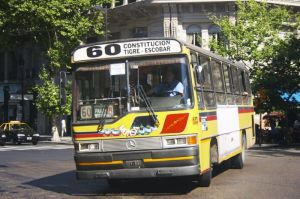
There’s an interesting article in La Nación today (link in Spanish) which gives some of the statistics regarding the Buenos Aires colectivo system, especially concerning the subsidy system which means that the passenger is only paying 32% of the actual ticket cost – the government picks up the rest of the tab to the tune of 7.5 million pesos per day.
There are 90 companies running 135 lines with a total of 9,559 vehicles (an average of 71 per line).
Every day each bus travels an average distance of 207 km and carries 470 passengers – that’s nearly 2,000,000 km travelled and 4.5 million individual journeys every day!
A Buenos Aires bus - drives to the moon 5 times a day
I haven’t won a lot of awards in my life. I got a commendation in French from my school when I was 14, and that’s about it. So you can imagine my excitement when I got an email this morning from the good people at Tripadvisor telling me that Buenos Aires Local Tours has been awarded a 2011 Certificate of Excellence, which is given to recognise consistently high ratings from Tripadvisor members!
I’ve been given 5 out of a possible 5 stars 20 times, which given that I’ve received 21 reviews is something I’m very proud of! Obviously I couldn’t have done this without the wonderful people who have come on the tour, the encouragement & kind words they have given me and my friends and family who have supported me in the last 6 months since I started – thank you all! If you haven’t yet been on a tour, then I look forward to seeing you soon!
Now that I’m getting to know parts of Buenos Aires very well, I love coming across old pictures and comparing what was there then with what you can be seen now. So, I was very interested to discover the picture below showing our meeting point of Plaza Italia taken in 1904, with the Zoo in the backround (Avenida Sarmiento on the left and Avenida Las Heras on the right).
Plaza Italia 1904
Compare to a shot from Google Earth taken from roughly the same direction (the statue is in the centre at the bottom):
Plaza Italia 2010
Not surprisingly, a lot has changed over the last 107 years, not least the fact that back then, there was no pedestrian square as there is now, and trams rumbled right past Garibaldi himself.
A notable difference are the gateways that once ringed Plaza Italia. Indeed, before being renamed in 1908, the square was known as Plaza de los Portones, Square of the Gates, which were closed at night to block access to the Parque 3 de Febrero, (los Bosques de Palermo). One remains today as the entrance to the zoo, and can be seen on the right of the picture.
I’ll tell anyone that listens that the best map of Buenos Aires is the Interactive Map on the Buenos Aires City Government site. With it you can easily find any street address and for planning a journey on public transport it’s indispensable.
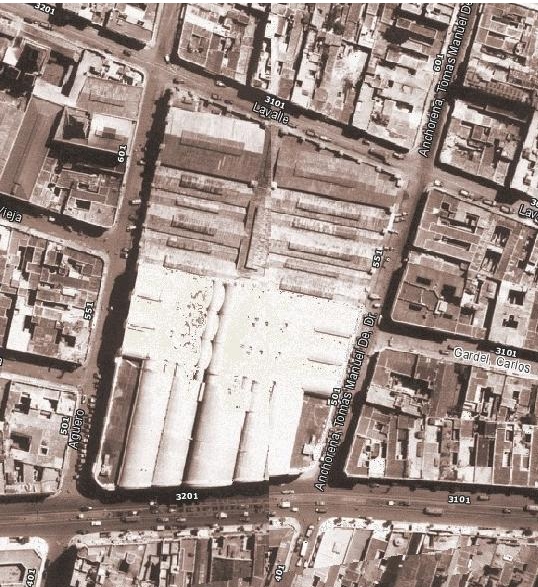
However, today I discovered a feature I’d not spotted before which makes me very happy indeed (it doesn’t take much). As well as the expected map and satellite views, it offers a choice of photographic overlays from times gone by. A satellite view from 2004 and aerial views from 1978, 1965 and 1940. I’ve spent most of the afternoon exploring 1940s Buenos Aires and am going to sharing some of the highlights here (click on all photos for larger views), most of which we visit in the daily tour.
Plaza De Mayo 1940
Completed around about the turn of the 20th Century, the Plaza de Mayo has not changed beyond recognition in the 71 years since this photo was taken. The main change is that the Casa Rosada was surrounded by roads on all four sides back then. Balcarce to its left as we look at it is now pedestrianised and the Paseo Colón passed right past the front of the building instead of looping round the gardens as it does now. Also, with fewer trees than nowadays, it’s easier to see the symmetry of the Plaza itself in the aerial view, something its hard to appreciate from ground level.
Avendia 9 de Julio in 1940
If the Plaza de Mayo hasn’t changed much, then the above shot shows an area that has undergone some major work. We all know the Avenida 9 de Julio these days as it cuts its way through the heart of the city. Well it hasn’t always been this way – back in 1940 it was only 5 blocks long and was more of a Plaza than an Avenida! The Obelisco had been built 4 or 5 years prior and it wouldn’t be for another 10 years until the buildings between Cerrito & Carlos Pelligrini would be levelled to extend the avenue. The Teatro Colón can be seen in the bottom left of the picture.
Caminito 1940
El Caminito, now one of the main tourist attractions in Buenos Aires was a long way from that in 1940. As the above picture shows it was then simply a spur of the main railway that served the docks. It wouldn’t be for another 15 years before local artist Benito Quinquela Martín would begin working on his vision of transforming it into Buenos Aires’ first open-air musuem.
Abasto 1940
The above picture shows one of the main sights of the tour, the market building in Abasto. At the time of this picture it had only been open for 5 years and would remain so for another 44 years. Clearly visible is the rear sections which is somewhat altered these days, but the front section remains intact as it was then. Also note the tramlines running up and down Corrientes. Buenos Aires once had one of the largest tram systems in the world (more than 850km of track at its peak) which was dismantled in the 1960s in favour of buses.
There is, of course, much more to be discovered with these wonderful old aerial shots and as I find more things of interest I’ll post them here.
Around the beginning of the 20th Century, when Don Rafael Diaz was 15 years old, he worked in a general store in the Montserrat area of Buenos Aires. He worked hard and even spent nights sleeping under the counter and the owner of the store would tell him that he would be rewarded for his hard work in heaven, where a house was waiting for him.
25 years later, in 1927, as owner of one of the largest furniture shops in Buenos Aires, he made this prediction come true by building his own little house in heaven, on top of his store, overlooking what is now el Obelisco & Plaza de la Republica.
The House on the 9 de Julio
The house, based on a Normandy-style chalet Don Rafael had seen in Mar del Plata, was his home for the following 40 years until he died in 1968. In the following years the business he had built up struggled to survive and in the 1970’s the building was sold and his chalet converted to offices. Today, surrounded by huge advertising hoardings, it’s not always easy to spot, but it’s still there – the only house in Buenos Aires with a view of the Obelisco.
Historical update, January 31, 2011: Turismo Visión later published the first part of the programme on the TVArg505 YouTube channel. The original upload is no longer available, so it is not embedded here.
Had a fun day yesterday as Argentinian tourism channel Turismo Visión came along to film the tour! They’d been looking for alternative ways to see the capital and loved the way we do things on colectivos and the Subte. It was very exciting and I can’t wait to see the final result – which should be in 2 weeks or so. Obviously you’ll see it here first!
Interviewing the tourists, Plaza Italia
The gang, Plaza de los Dos Congresos
Filming the introduction, Plaza Italia
Cookie Consent
We use optional cookies to improve your experience. Sadly, no real cookies.
Cookie Preferences
Manage your cookie preferences below:
Essential cookies enable basic functions and are necessary for the proper function of the website.
Name
Description
Duration
Geolocation Config
This cookie is used to store the consent settings based on the visitor's location.
350 days
Cookie Preferences
This cookie is used to store the user's cookie consent preferences.
350 days
CloudFlare provides web performance and security solutions, enhancing site speed and protecting against threats.
The cf_ob_info cookie provides information on: The HTTP Status Code returned by the origin web server. The Ray ID of the original failed request. The data center serving the traffic
session
__cfseq
Sequence rules uses cookies to track the order of requests a user has made and the time between requests and makes them available via Cloudflare Rules. This allows you to write rules that match valid or invalid sequences. The specific cookies used to validate sequences are called sequence cookies.
session
cf_clearance
Whether a CAPTCHA or Javascript challenge has been solved.
session
_cfuvid
The _cfuvid cookie is only set when a site uses this option in a Rate Limiting Rule, and is only used to allow the Cloudflare WAF to distinguish individual users who share the same IP address.
session
__cflb
When enabling session affinity with Cloudflare Load Balancer, Cloudflare sets a __cflb cookie with a unique value on the first response to the requesting client. Cloudflare routes future requests to the same origin, optimizing network resource usage. In the event of a failover, Cloudflare sets a new __cflb cookie to direct future requests to the failover pool.
session
__cfruid
Used by the content network, Cloudflare, to identify trusted web traffic.
session
__cf_bm
Cloudflare's bot products identify and mitigate automated traffic to protect your site from bad bots. Cloudflare places the __cf_bm cookie on End User devices that access Customer sites that are protected by Bot Management or Bot Fight Mode. The __cf_bm cookie is necessary for the proper functioning of these bot solutions.
session
cf_chl_rc_m
These cookies are for internal use which allows Cloudflare to identify production issues on clients.
session
cf_chl_rc_ni
These cookies are for internal use which allows Cloudflare to identify production issues on clients.
session
cf_chl_rc_i
These cookies are for internal use which allows Cloudflare to identify production issues on clients.
session
__cfwaitingroom
The __cfwaitingroom cookie is only used to track visitors that access a waiting room enabled host and path combination for a zone. Visitors using a browser that does not accept cookies cannot visit the host and path combination while the waiting room is active.
session
cf_use_ob
The cf_use_ob cookie informs Cloudflare to fetch the requested resource from the Always Online cache on the designated port. Applicable values are: 0, 80, and 443. The cf_ob_info and cf_use_ob cookies are persistent cookies that expire after 30 seconds.
session
These cookies are needed for adding comments on this website.
Name
Description
Duration
comment_author_url
Used to track the user across multiple sessions.
Session
comment_author_email
Used to track the user across multiple sessions.
Session
comment_author
Used to track the user across multiple sessions.
Session
Google Tag Manager simplifies the management of marketing tags on your website without code changes.
Name
Description
Duration
td
Registers statistical data on users' behaviour on the website. Used for internal analytics by the website operator.
session
cookiePreferences
Registers cookie preferences of a user
2 years
Name
Description
Duration
nitropack_webhook_sync
Session
nitroCachedPage
Session
WP Consent API is a plugin that standardizes the communication of accepted consent categories between plugins.
Name
Description
Duration
wp_consent_{category}
Stores your consent preference for a specific cookie category (e.g., functional, marketing). It ensures consistent consent management across WordPress plugins supporting the WP Consent API.
30 days
Statistics cookies collect information anonymously. This information helps us understand how visitors use our website.
Google Analytics is a powerful tool that tracks and analyzes website traffic for informed marketing decisions.
Used to monitor number of Google Analytics server requests when using Google Tag Manager
1 minute
_gid
ID used to identify users for 24 hours after last activity
24 hours
_ga_
ID used to identify users
2 years
_gali
Used by Google Analytics to determine which links on a page are being clicked
30 seconds
_ga
ID used to identify users
2 years
__utmx
Used to determine whether a user is included in an A / B or Multivariate test.
18 months
__utmv
Contains custom information set by the web developer via the _setCustomVar method in Google Analytics. This cookie is updated every time new data is sent to the Google Analytics server.
2 years after last activity
__utmz
Contains information about the traffic source or campaign that directed user to the website. The cookie is set when the GA.js javascript is loaded and updated when data is sent to the Google Anaytics server
6 months after last activity
__utmc
Used only with old Urchin versions of Google Analytics and not with GA.js. Was used to distinguish between new sessions and visits at the end of a session.
End of session (browser)
__utmb
Used to distinguish new sessions and visits. This cookie is set when the GA.js javascript library is loaded and there is no existing __utmb cookie. The cookie is updated every time data is sent to the Google Analytics server.
30 minutes after last activity
__utmt
Used to monitor number of Google Analytics server requests
10 minutes
__utma
ID used to identify users and sessions
2 years after last activity
_gac_
Contains information related to marketing campaigns of the user. These are shared with Google AdWords / Google Ads when the Google Ads and Google Analytics accounts are linked together.
90 days
Marketing cookies are used to follow visitors to websites. The intention is to show ads that are relevant and engaging to the individual user.
Google Ads is an online advertising platform that enables businesses to create targeted ads displayed on Google search results and partner sites.
Google uses cookies for advertising, including serving and rendering ads, personalizing ads (depending on your ad settings at g.co/adsettings), limiting the number of times an ad is shown to a user, muting ads you have chosen to stop seeing, and measuring the effectiveness of ads.
90 Days
FPGCLGB
Google uses cookies for advertising, including serving and rendering ads, personalizing ads (depending on your ad settings at g.co/adsettings), limiting the number of times an ad is shown to a user, muting ads you have chosen to stop seeing, and measuring the effectiveness of ads.
90 Days
_gac_gb_
Google uses cookies for advertising, including serving and rendering ads, personalizing ads (depending on your ad settings at g.co/adsettings), limiting the number of times an ad is shown to a user, muting ads you have chosen to stop seeing, and measuring the effectiveness of ads.
90 Days
_gcl_gb
Google uses cookies for advertising, including serving and rendering ads, personalizing ads (depending on your ad settings at g.co/adsettings), limiting the number of times an ad is shown to a user, muting ads you have chosen to stop seeing, and measuring the effectiveness of ads.
90 Days
_gcl_gs
Google uses cookies for advertising, including serving and rendering ads, personalizing ads (depending on your ad settings at g.co/adsettings), limiting the number of times an ad is shown to a user, muting ads you have chosen to stop seeing, and measuring the effectiveness of ads.
90 Days
_gcl_aw
Google uses cookies for advertising, including serving and rendering ads, personalizing ads (depending on your ad settings at g.co/adsettings), limiting the number of times an ad is shown to a user, muting ads you have chosen to stop seeing, and measuring the effectiveness of ads.
90 Days
Conversion
Google uses cookies for advertising, including serving and rendering ads, personalizing ads (depending on your ad settings at g.co/adsettings), limiting the number of times an ad is shown to a user, muting ads you have chosen to stop seeing, and measuring the effectiveness of ads.
90 days
__Secure-3PSID
Targeting cookie. Used to profile the interests of website visitors and display relevant and personalised Google ads.
2 years
__Secure-1PAPISID
Targeting cookie. Used to create a user profile and display relevant and personalised Google Ads to the user.
2 years
__Secure-1PSIDTS
Targeting cookie. Used to create a user profile and display relevant and personalised Google Ads to the user.
2 years
__Secure-3PSIDTS
Targeting cookie. Used to create a user profile and display relevant and personalised Google Ads to the user.
2 years
__Secure-3PSIDCC
Targeting cookie. Used to create a user profile and display relevant and personalised Google Ads to the user.
2 years
ADS_VISITOR_ID
Cookie required to use the options and on-site web services
2 months
AEC
AEC cookies ensure that requests within a browsing session are made by the user, and not by other sites. These cookies prevent malicious sites from acting on behalf of a user without that user's knowledge.
6 months
__Secure-3PAPISID
Profiles the interests of website visitors to serve relevant and personalised ads through retargeting.
2 years
__Secure-1PSIDCC
Targeting cookie. Used to create a user profile and display relevant and personalised Google Ads to the user.
2 years
__Secure-1PSID
Targeting cookie. Used to create a user profile and display relevant and personalised Google Ads to the user.