Cafe Tortoni

When it comes to bars and cafes in Buenos Aires, there can be no doubt that the Tortoni is the grandaddy of them all. It’s the oldest café in Argentina, opened in 1858, situated in the heart of the action on the Avenida de Mayo, it doesn’t get a lot more notable than this.

IMG_1262

With its history and reputation, it’s not a surprise to find that the Tortoni is very popular on the tourist route, and it’s not unusual to see queues of 20 to 30 people waiting to get in during the summer season.

IMG_1268

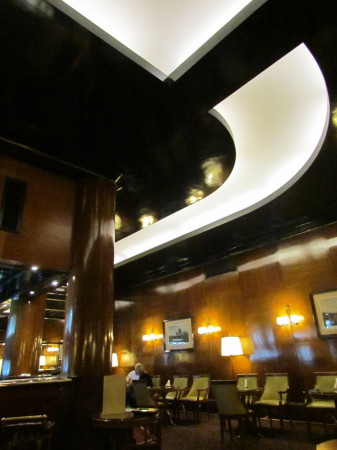
It’s not difficult to see what the fuss is about – once you are ushered in through the wood and glass doors, the Tortoni is beautiful. Stained glass, dark wood and polished brass fittings take you back to the 19th century, an image also helped by the legions of bow-tie wearing waiters rushing about.

IMG_1267

The Tortoni is by far the biggest name in the Notable Bar world and is definitely worth a visit. If you can avoid it during the high season when it turns into a tourist zoo, you’ll be rewarded with one of the greatest cafes in the world.

Cafe Tortoni: Avenida de Mayo 825
Subte: Piedras, Line A

This page is part of a series examining the Notable Bars of Buenos Aires.

Cafe Nostalgia

Cafe Nostalgia is the first bar I ever went to in Buenos Aires. A friend had told me to go there and meet the owners who were friends of his. I went there on my very first day in the city, they weren’t there and I didn’t return for nearly 7 years.

IMG_8733

Which, I can see now, is a shame because it’s a nice little place. Nestled on a residential corner in leafy Palermo Viejo, it’s got enough of a comfortable feel that you would happily sit there for an hour or two nursing a coffee, and it’s quiet enough to do so.

IMG_8734

In many ways, Cafe Nostalgia is exactly what a neighbourhood bar should be – there’s nothing fancy about it (except a rare goose-neck tap) but it’s warm and welcoming and would be a great little local to have nearby.

IMG_8735

Cafe Nostalgia: Soler
Subte: Bulnes, Line D

This page is part of a series examining the Notable Bars of Buenos Aires.

Varela Varelita

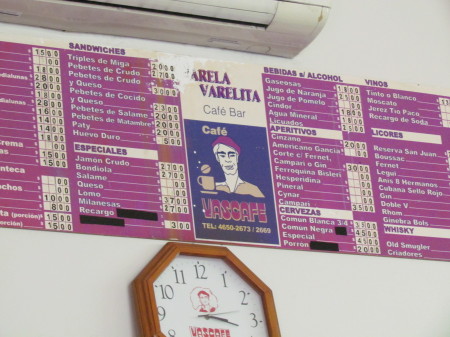
I must have walked past Varela Varelita hundreds of times and never taken much notice of it. There is not much to notice on the outside and inside it has that sparse and initially unfriendly feel, that many of the old-school style bars have.

IMG_8738

It’s been open for more than 40 years and, like many of its colleagues, does not seem to have changed a lot in that time. The original owner sold it 20 years ago but he still comes in for a drink ever now and then.

IMG_8739

I wouldn’t go out of my way to Varela Varelita but it’s a mere stone’s through from the tourist havens of Palermo Soho so it’s definitely worth a visit if you’re in the area and would like to see what a real Buenos Aires bar is like.

Varela Varelita: Av Raúl Scalabrini Ortiz 2102
Subte: Scalabrini Ortiz, Line D

This page is part of a series examining the Notable Bars of Buenos Aires.

Claridge

One of 4 notable bars situated in a hotel, the Claridge bar is a cosy place which reminded me of hotel bars in the UK. Big, comfortable green leather seats, dark wood, beamed ceiling and decorative windows, it also suffers from the problem that a lot of hotel bars in UK suffer from, which is to say a distinct lack of character.

IMG_7928

I couldn’t find anything especially wrong with the Claridge, but as it filled up with an early evening crowd of hotel residents, there was very little I actively liked about it either.

IMG_7929

Part of the problem was that it reminded so much of places I know in the UK, that I could find very little of Buenos Aires in there. As notable as it may be, I think that I need just a touch more local colour for a bar to stand out.

IMG_7930

Claridge: Tucuman 535
Subte: Florida, Line B

This page is part of a series examining the Notable Bars of Buenos Aires.
Plaza Bar

The Plaza Hotel on Plaza San Martín opened in 1909 and was considered to be one of the finest hotels in the world at the time, and the first of the grand hotels to open in Buenos Aires.

We had to ask for directions in the cramped lobby, as the bar is not easy to find but we eventually found it at the end of a corridor and down some stairs.

IMG_7920

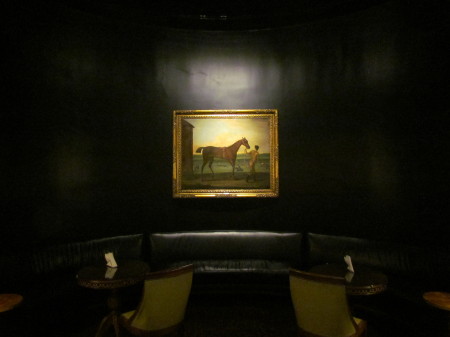
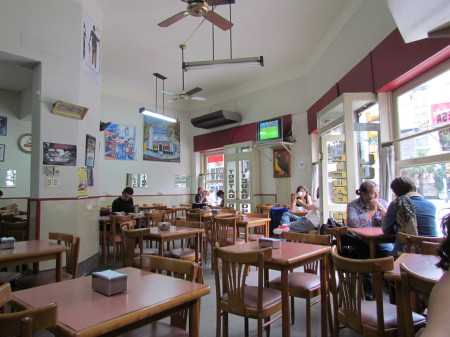
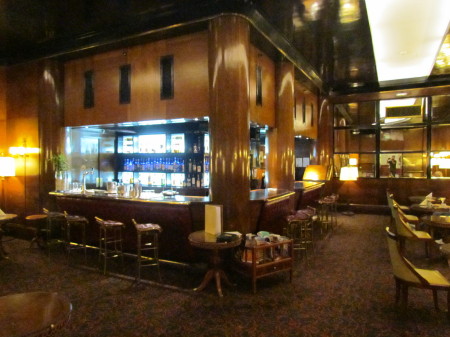
Being below street level there is no natural light in the bar, so it’s a shame that the bar is decorated in very dark and sombre colours. It’s well decorated and I could see myself happily spending a grey and rainy afternoon tucked away in a corner reading a book, but on a sunny February afternoon it’s not the place to linger.

IMG_7922

As a bar, it definitely has its attractions, and its location and history certainly qualify as notable but I’m just not convinced that the Plaza Bar is my kind of place.

IMG_7918

Plaza Bar: Florida 1001
Subte: San Martín, Line C

This page is part of a series examining the Notable Bars of Buenos Aires.
Café Roma

Getting off the bus in La Boca, we headed straight for Café Roma. I had high hopes for this one – on my way to Caminito on the tour I had passed by the bar many times and would nearly always catch a glimpse of an old boy sitting at a window table with the cortado, reading the newspaper.

Image0475

To begin with however, our quest was hindered by the fact that whilst the bar was obviously not shut, a large group could be seen inside singing and dancing, it was a private party and we were not on the list. Undeterred we headed off into darkest Boca and visited La Perla and El Estaño, before returning a couple of hours later.

Image0486

The party hadn’t quite finished, but was certainly winding down, and we were quickly found a couple of tables and we settled in. The organiser of the party, a 70 year-old Boca resident called Titina explained that she and a group of friends got together every month in a different bar for food and karoake. She invited us to come to her birthday party next month.

Image0485

The bar itself had everything I hoped for from the usual dark wood fittings, chairs and tables, old metal signs on the walls and most importantly a real sense of character. Any bar that closes to the public and hires itself out to a group of locals on a Saturday afternoon for 3 hours is OK with me.

Image0487

Café Roma: Olavarría 409
Colectivos: 152, 29, 64

This page is part of a series examining the Notable Bars of Buenos Aires.

El Estaño 1880

I wanted to like El Estaño, I really did. Estaño means tin and it refers to the original metal bar, which with the closure of Bar Carlitos, is apparently the only one remaining in the city. As you may be able to guess from its name, it opened in 1880, and it now situated a couple of blocks from the legendary Bombonera stadium, home to Boca Juniors.

Image0482

The interior is nicely decorated, with glass-fronted cabinets lining the walls behind the bar and a large mural taking up the entire back wall and a lively air conditioner keeping the worst of the January heat out. So what’s the problem then?

When we arrived there was one of the city’s yellow open-top tourist buses parked outside. Entering the bar, it became clear that all of the clientele had been herded off the bus, into the bar where they were drinking overpriced Quilmes. We sat down and waited. None of the 4 staff behind the bar made any move towards the table. After 5 minutes it became obvious that you had to go the the till at the end of the bar to order and collect your drinks from an incredibly surly lady.

Image0481

10 minutes after we arrived, everyone except us was herded back onto the bus, and not 10 seconds after it left another one arrived and the whole process started again. After another 10 minutes we were again the only people in the bar (and obviously not on the yellow bus) and we began talking to the staff about other Notable Bars in La Boca and they brightened up and became quite chatty.

Despite this, the whole experience was so manufactured and cynical – we even speculated that the bar is now owned by the bus company – that I will not be returning in a hurry. Along with La Perla, two beautiful and historical bars have had all traces of character removed in the name of “tourism”.

El Estaño 1880: Aristóbulo del Valle 1100
Colectivos: 10, 39

This page is part of a series examining the Notable Bars of Buenos Aires.

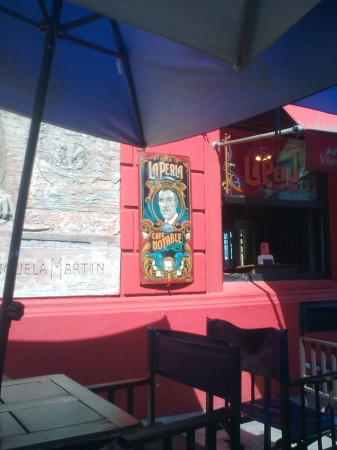
La Perla de Caminito

Image0476

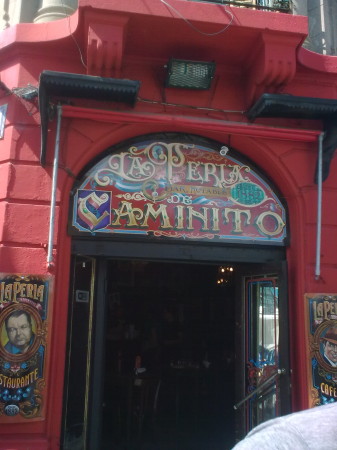
I visit Caminito a lot with the tour. The people I take always seem to enjoy it, but I must confess it’s not a place I particularly enjoy visiting. Whilst the houses are undoubtably bright and pretty, the whole area is a massive tourist trap and is about as far removed from the Buenos Aires I know as you can get.

Image0477

Which is why I passed in front of this bar dozens, if not hundreds, of times and never had the slightest desire to go in. But in the name of research we hit La Boca on a very hot Saturday afternoon and had a beer sat outside of La Perla de Caminito.

Image0478

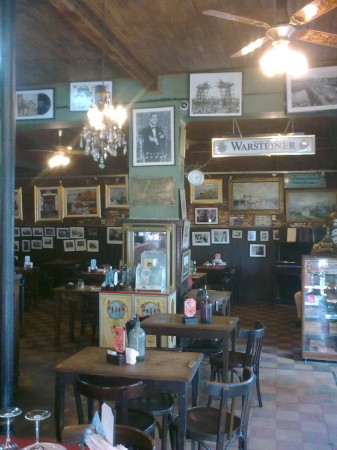
The place is decorated as you would expect a Notable Bar to be, but it lacks any personality. Like the rest of Caminito, it was exactly as I thought it would be, overpriced and forgettable.

La Perla de Caminito: Av Don Pedro de Mendoza 1899
Colectivos: 29, 64

This page is part of a series examining the Notable Bars of Buenos Aires.

Café de Garcia

When I first started researching the Notable Bars of Buenos Aires, I hadn’t been living in Buenos Aires long and Café de Garcia stood out as the kind of place I wanted to visit – it’s out on the edge of the city, a long way from Palermo and being away from the tourist bubble I hoped it would get me close to the “real” Buenos Aires bar.

IMG_7766

So, when I finally made it out there, would I be disappointed? Simply put, no – it lived up to all of my expectations. There’s plenty of seating outside, but more than half of the interior is taken up with billiard tables. I took this as a good sign – anywhere that it willing to sacrifice that much space for old boys to play bar games is OK with me.

IMG_7765

Many of the Notable Bars have walls lined with paraphernalia of various kinds, from football banners to car parts. Café de Garcia however has struck the motherlode as it proudly features a genuine legendary artifact, a football top signed by one-time
Villa Devoto resident, Diego Maradona.

IMG_7770

This is not what people come to Café de Garcia for however – it is renowned for its legendary (according to them) picada. A picada normally consists of a few chunks of ham, cheese and salami, served on a wooden board and washed down with a cold Quilmes.

IMG_7764

The Garcia’s picada is a monster of a thing – the waiter proudly showed us the list of delights that will be brought to your table (should you be lucky enough to get one – reservations of at least a week in advance are advisable we were told). Even champagne is included.

IMG_7774

Served in a backroom, itself cluttered with enough memorabilia to start a flea market stall, they are obviously very proud of their signature meal – the waiter spent at least 20 minutes talking about it. We didn’t get to try it this time, but we’ll be back.

IMG_7778

Café de Garcia: Sanabria 3302
Train: Devoto, Linea San Martín

This page is part of a series examining the Notable Bars of Buenos Aires.
Café Olimpo

IMG_7761

Most staff in the majority of the Notable Bars I’ve visited have been happy to chat about the history of the bar, tell me what makes it notable and in most cases, wax lyrical about how things were better in the old days. Café Olimpo in Villa Luro takes that one step further and provides you with a fairly hefty written history to read.

IMG_7755

Now, I must confess that I didn’t read the whole thing, but I did grasp that the reason that the walls are covered in automobile parts is that the area was home to several car factories back in the day – we also saw a sign for the Automotive Museum not too far away in Monte Castro.

IMG_7757

We also learn that the bar was home to the first TV Set in the area so in the early 60s was packed every night with locals eager to watch early versions of Bailando Por Un Sueño. The mind boggles. The TV is still there, but from what we could see, the crowds aren’t. We were the only clients in the 30 minutes we spent there.

IMG_7762

Like so many of the more far-flung bars on the Notable list the Olimpo has a real sense of community, a real sensation that it plays (or more often, played) and important role in the local neighbourhood. Over the years it has brought people together and given them somewhere to meet and talk, both very important things for Argentines.

IMG_7756

Café Olimpo: Irigoyen 1491, Villa Luro
Colectivos: 106, 108, 109

This page is part of a series examining the Notable Bars of Buenos Aires.